

One week you feel unstoppable. You sleep less, talk faster, make bigger plans, spend more freely, and feel unusually confident. Then the shift comes. Your energy crashes. Getting out of bed feels heavy. Work becomes harder. Conversations feel exhausting. You start wondering whether this is stress, burnout, depression, or something more serious. That is often where people begin searching for a bipolar disorder self-test.
The most important thing to know at the start is this: a bipolar self-test can be a useful screening step, but it cannot diagnose bipolar disorder.
A diagnosis requires a trained mental health professional who can look at your symptoms over time, ask about past episodes of mania or hypomania, review family history, and rule out other explanations such as substance use, thyroid disease, or other psychiatric conditions.
The National Institute of Mental Health notes that diagnosis depends on the course of symptoms over days and weeks, not just what a person feels in one moment. NICE guidance likewise treats bipolar disorder as a condition that requires formal assessment and careful management, not something that can be confirmed by an online quiz.
In the United States, an estimated 2.8% of adults have bipolar disorder in a given year, and 4.4% experience it at some point in life. Among adults with bipolar disorder in the past year, 82.9% had serious impairment, which helps explain why early recognition matters so much.
What Is the Bipolar Disorder Self-Test?
While the self-test can help recognize some signs, it is not a substitute for a professional diagnosis. If your results suggest that you may have bipolar disorder, it is important to reach out to a healthcare provider who can provide a more thorough assessment and guide you through the next steps for treatment.
A bipolar disorder self-test is a short questionnaire designed to flag patterns that may be consistent with bipolar symptoms. Most ask about periods of unusually high energy, reduced need for sleep, racing thoughts, impulsive behavior, irritability, and depressive symptoms such as hopelessness, low motivation, or loss of interest.
These tools are useful because bipolar disorder is not always obvious, especially when a person seeks help during a depressive phase and does not recognize past hypomanic symptoms as clinically important. NIMH notes that bipolar disorder can be misdiagnosed when clinicians focus only on current symptoms instead of the full course of illness.
The key phrase here is full course of illness. Someone may show up reporting exhaustion, sadness, and poor concentration, which can look like major depression. But if they also had periods of unusually increased energy, decreased need for sleep, risky behavior, or inflated confidence, the diagnostic picture changes. That is why screening tools can be valuable. They do not diagnose bipolar disorder, but they can raise the right question early enough to prompt a proper evaluation.
A 2024 review in World Psychiatry put it clearly: self-administered questionnaires are not substitutes for interviewer-based diagnostic evaluations; they are screening instruments used in the first stage of a two-stage process.
“Self-administered questionnaires are not a substitute for an interviewer-based diagnostic evaluation.”
That single point should shape how readers interpret every self-test result.
How the Bipolar Disorder Test Works?

Most bipolar screening tools focus on two broad domains: elevated or activated mood states and depressive states. Elevated states may involve feeling unusually energetic, needing much less sleep, becoming more talkative, feeling more powerful or confident than usual, acting impulsively, or taking risks that later seem out of character.
Depressive states often involve low mood, reduced motivation, slowed thinking, fatigue, hopelessness, or loss of interest in activities.
What makes bipolar screening difficult is that many people seek help during the low phase, not the high phase. Hypomania can feel productive, exciting, or even normal to the person experiencing it. That means they may underreport it, dismiss it, or fail to connect it with later depressive crashes.
This is one reason bipolar disorder can be missed or mislabeled as unipolar depression. NIMH specifically warns that treating an initial depressive episode with antidepressants alone, without recognizing bipolarity, can trigger mania or rapid cycling in some people.
“Bipolar disorder is often misdiagnosed, and self-testing is a way for people to begin the conversation with their doctors.” – Dr. John M. Grohol, founder of PsychCentral.
The Best-Known Bipolar Screening Tools
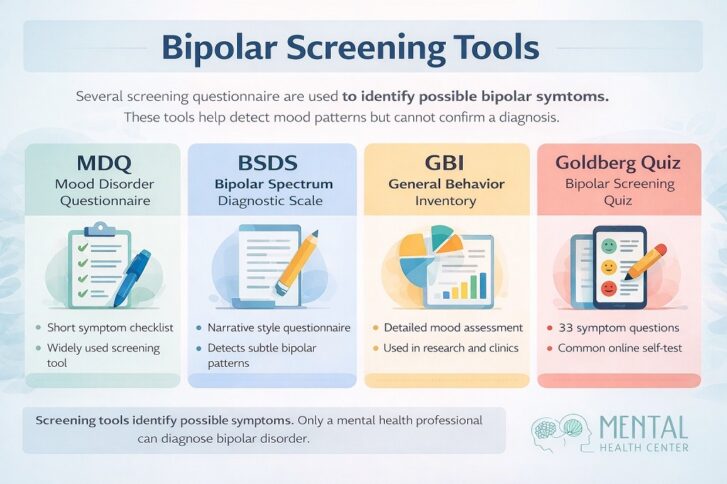
Mood Disorder Questionnaire or MDQ
The MDQ is the most widely known bipolar screening questionnaire. It was developed as a brief patient-rated tool to identify bipolar spectrum symptoms and remains one of the most studied instruments in this area. According to StatPearls, the MDQ has reported sensitivity of about 80% and specificity of about 70%, though performance varies by setting and population. That means it can be helpful, but it is far from perfect. It is generally better at detecting bipolar I disorder than bipolar II disorder and may perform less well in community samples than in psychiatric settings.
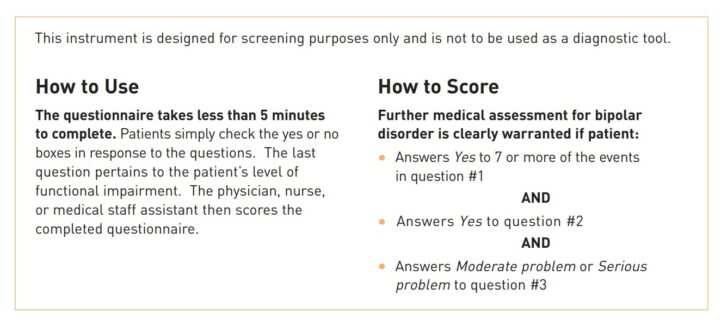
The MDQ is useful because it is short and easy to complete. The drawback is that its simplicity can flatten a complex disorder into a yes or no score. A positive result does not confirm bipolar disorder, and a negative result does not fully rule it out.
Bipolar Spectrum Diagnostic Scale or BSDS
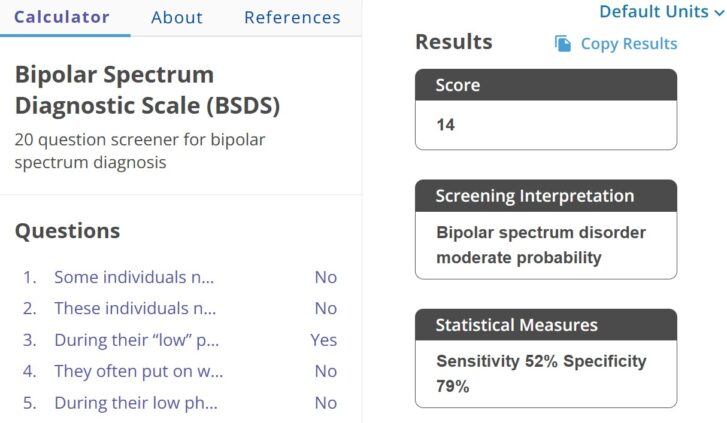
The BSDS takes a different approach. Instead of a simple symptom checklist, it uses a narrative format that describes a bipolar-spectrum pattern and asks the person how closely it fits their experience.
In the original validation study, the BSDS showed sensitivity of 0.76 and identified 85% of unipolar depressed patients as not having bipolar spectrum illness. Specificity increased from 0.85 to 0.93 when the positive threshold was adjusted. That made it especially useful for detecting subtler or spectrum presentations that may not fit the classic image of mania.
This is important because many people do not present with obvious, dramatic mania. Some experience milder hypomanic states, mixed symptoms, or patterns that are easier to miss. The BSDS was designed partly to capture that nuance.
General Behavior Inventory or GBI
The GBI is longer and more detailed than the MDQ. It is often described as one of the more thoroughly validated measures of bipolar mood symptoms, especially in research settings. Because it examines symptom patterns more broadly and over time, it can offer a deeper picture than a short screener. The tradeoff is that it is less convenient for quick online self-testing.
In practical terms, the GBI is more useful when someone needs a fuller symptom profile rather than a fast initial screen.
Goldberg Bipolar Spectrum Screening Quiz

The Goldberg Bipolar Spectrum Screening Quiz is a 33-item questionnaire that covers a wide range of symptoms related to bipolar disorder. This test assesses the frequency and intensity of mood swings, sleep patterns, impulsive behaviors, and changes in social activity.
It’s often used to determine if an individual should pursue further evaluation. The quiz is thorough and can be an important first step in understanding whether bipolar disorder might be present.
Bipolar Disorder Self-Assessment Tool by SaicoTalk
The Bipolar Disorder Self-Assessment Tool by SaicoTalk is a simpler self-assessment that focuses on mood swings, energy levels, and behavior patterns. It’s a short yet helpful tool for people who might suspect they have bipolar disorder.
Although less comprehensive than others, it serves as a useful starting point for individuals to evaluate their symptoms and consider seeking further evaluation.
The Structure of a Bipolar Disorder Self-Test
Bipolar disorder tests often use a simple question-and-answer format, where individuals rate their symptoms on a scale. For instance, one question might ask how often a person feels unusually energetic or impulsive, while another might ask about how often they feel sad or uninterested in activities. These questions allow individuals to reflect on how frequently certain symptoms have occurred in their lives.
“While self-tests can’t replace a full diagnostic evaluation, they provide a preliminary screening that can help people understand their behavior patterns more clearly.” – Dr. Maria L. Shriver, clinical psychologist.
Dr. Shriver points out that while self-tests provide valuable insights, they are not definitive. They serve as an entry point for individuals to recognize their symptoms and decide whether to pursue further evaluation.
Accuracy and Limitations of the Bipolar Disorder Self-Test

It’s important to recognize the limitations of the bipolar disorder test. The test’s accuracy can be influenced by how well an individual understands their own symptoms. In particular, people experiencing manic episodes might not recognize their symptoms, leading to inaccurate responses.
Dr. Debra Rose Wilson, a clinical psychologist, notes that “A bipolar disorder self-test can help you understand your symptoms. But you’ll need a mental health professional for an official diagnosis.”
The Role of Family History in the Bipolar Disorder Test
Family history deserves more space than your current draft gives it, because it is one of the strongest clinical clues. NIMH notes that looking at family history can help determine whether bipolar disorder is present.
Family studies have shown that first-degree relatives of people with bipolar disorder have about a 10-fold higher risk than the general community, and heritability estimates are commonly reported in the 60% to 80% range.
That does not mean bipolar disorder is determined by one single gene or that family history guarantees the disorder will appear. It does mean clinicians take it seriously when evaluating someone with mood instability, recurrent depression, or possible hypomanic symptoms.
- Has anyone in your family been diagnosed with bipolar disorder?
- Do you have a close relative who experiences severe mood swings?
“Family history plays a significant role in the development of bipolar disorder. Studies show that individuals with a first-degree relative diagnosed with the condition are up to 10 times more likely to develop it themselves.” – Dr. Francis McMahon, Chief of the Human Genetics Branch at the National Institute of Mental Health (NIMH)
References
-
- National Institute of Mental Health (NIMH) – Bipolar Disorder
- NICE – Bipolar disorder: assessment and management
- Mental Health Center – Bipolar Disorder: Causes, Symptoms
- World Psychiatry / WPA – World Psychiatry June 2024 PDF
- StatPearls / NCBI Bookshelf – Mood Disorder Questionnaire
- QxMD – Bipolar Spectrum Diagnostic Scale (BSDS)
- NovoPsych – General Behaviour Inventory (GBI)
- Psychiatry Associates – Goldberg’s Bipolar Screening Scale PDF
- SaicoTalk – Bipolar Disorder Self-assessment Tool PDF
- PMC / National Library of Medicine – Family studies of bipolar disorder and risk
- MedlinePlus Magazine – Large families may hold answers to bipolar disorder
- Healthline – Bipolar Self-Test
Final Thoughts
A bipolar disorder self-test can be useful for one reason: it may help a person notice patterns they had not put together before. That alone can be valuable, especially in a condition that is often overlooked when symptoms first appear as depression, anxiety, irritability, or burnout. But the test is only a starting point. A score cannot tell you whether you truly have bipolar disorder, which subtype may be present, whether another condition explains the symptoms better, or what treatment is appropriate. That requires a full clinical assessment.
The strongest, most trustworthy message for readers is this: use a self-test as a prompt, not a verdict. If the results raise concern, take them seriously enough to speak with a qualified professional. That is where screening becomes something useful instead of something misleading.